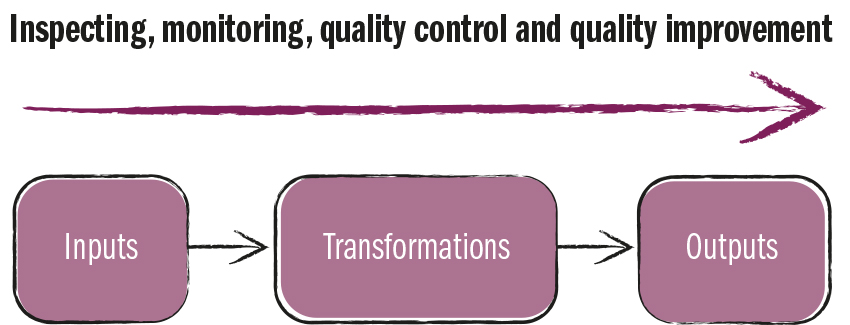
Every business must consider how it will produce goods and supply services. The transformation processes are those activities that determine how value will be added through the combination of inputs.
These processes can add value in four ways:
physical altering of the physical inputs or the changes that happen to people when they use a service
transportation of goods or services, such as delivering to a more convenient location for consumers
protection and safety; for example, a bank keeps savings secure
information, by providing customers a better understanding of the features of the product and how it operates.
Consider how value is added through the transformation process in a bike shop. A local bike shop offers bikes for sale and carries a range of brands and types. Sales staff can explain the difference between different styles of bike, brands and quality, matching a customer to what best suits their purpose. For a particular customer who wants a more specialised bike for racing, the shop can value add in different ways. First, the owner can source a quality carbon fibre frame from a distributor and a range of components such as wheels, gears and cranks. The owner can employ a bike mechanic to build the bike, using the different components to create a value-for-money road racer for under $2000, which was the customer’s budget. By sourcing and bringing all the components together at the local bike store, the shop adds value from transport. As the customer cannot afford to purchase the bike all at once, the shop keeps the bike securely in a locked room until final payment is made. Finally, when the customer pays for and picks up the new bike, the owner will take time to carefully explain the value, performance and features of each component used to create this unique product, thereby adding further value.
Producing a product can be done in a range of different ways. The operations manager must select the optimal process, considering the following factors:
available capacity of the facility
available knowledge and skills of employees
type of production, whether it be job, batch or flow production
layout of plant and equipment
work health and safety
production costs
maintenance requirements.
The transformation process therefore needs to be designed, planned and controlled to make this process efficient and effective.
Influences – volume, variety, variation and visibility
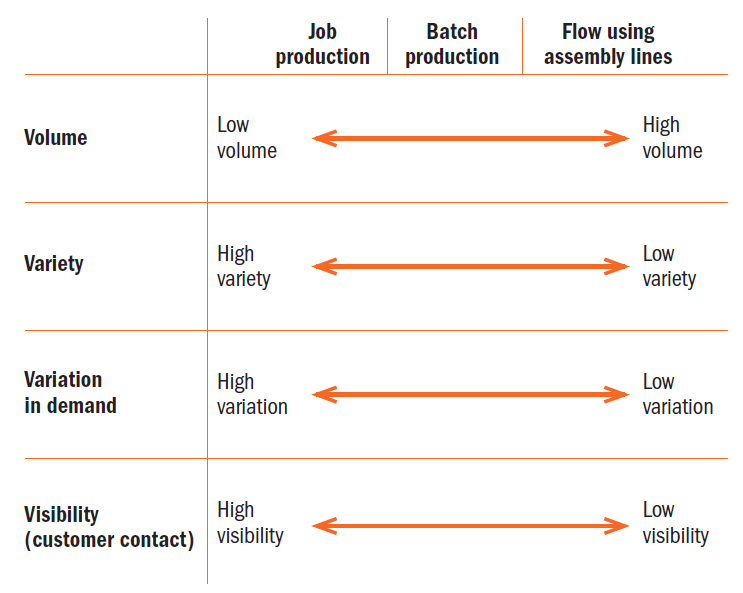
There are four dimensions of operations – volume, variety, variation and visibility to customers – which are referred to as the four Vs. For different types of businesses, one of the four Vs will be the most important influence on the type of production used by the business. There are three types of production: job production, batch production and flow production.
Job production, also known as jobbing, suits those products and services that require much higher quality and customisation than the standard product. Outputs are made on demand to suit what the customer requests. It is a highly flexible system but with a low output. There tends to be less capital and more emphasis on high labour content and skill. As a result, job production is much more time-consuming because there is greater consultation between the business and the customer. At the extreme end are projects such as building a unique architecturally designed home as a one-off job. In this type of project, costs per unit will be quite high.
Source 3.7 Bakeries produce different breads using the same process in large batches.
Batch production is similar to jobbing, except products are made in groups or batches. A good example is a bakery that makes a number of slightly different breads, using the same process and produced in batches of 50 to 200. There is emphasis on quality at an affordable price. Batch production requires careful planning so the production can be switched between products. Inputs will need to be changed and machinery recalibrated. However, the advantages of batch production are that it can produce different varieties of a good and deal with unexpected increases in demand.
Flow production (or line production) involves a continuous flow of inputs and outputs through the operations and is often associated with assembly lines. Products tend to have little variation; therefore, there is a high-volume output of a standardised product. Labour will be used to supervise equipment. Fuel refineries use a continuous flow process in which it is extremely difficult to halt production. Costs per unit tend to be low, owing to the high level of automation and economies of scale.
A business that must be a high-volume producer, such as a mining company or car assembly factory, will have to use flow production. A business that must produce a variety of models with different features requiring considerable skill will use batch production and even jobbing. Batch production will suit a business that must satisfy variations in demand. As demand for a particular good increases, the business can simply add more batches of the same product and delete batches of products not in demand.
Volume
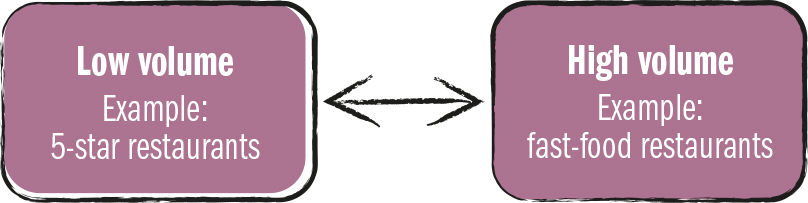
Volume is the actual number of products or services produced by the operation. A business using flow production will produce a high volume with a high degree of process repetition. The number of items produced will be in the hundreds or thousands. The implication for operations when volume has the strongest influence is that there will be a large amount of capital, facilities, technology and materials used and much less labour. Assembly lines using conveyor belts will be common and will be organised in a fixed sequence of activities.
Source 3.8 Volume of production can differ significantly between different types of businesses within a particular industry.
Source 3.8 Volume of production can differ significantly between different types of businesses within a particular industry.×
Low-volume operations, producing only a small number of items, will use much less equipment with the emphasis on multiskilled labour and may be involved in a ‘craft’-type industry such as wedding dress design. A business that has low costs as its objective will use a high-volume operation, while a business that chooses product differentiation and flexibility will use a low-volume operation.
Variety
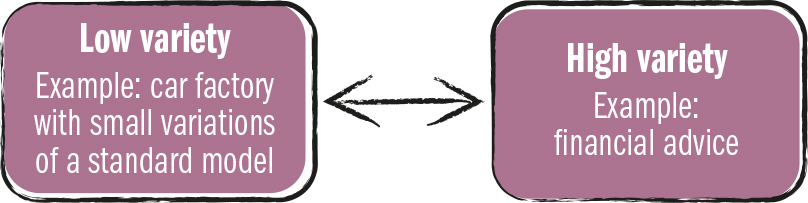
Variety refers to the number of different models and variations offered by a business in its products or services. If the business has customers with different needs, goods and services will have to be modified or a wide variety of models and options will need to be provided. The business will probably rely on using sophisticated technology so that it can change production from one product to another without too much disruption to the operations process. Low-variety operations are routine in producing a high volume of a standardised product at a low cost.
Source 3.9 The variety of products and services offered by a business will depend on the different needs of its customer base.
Source 3.9 The variety of products and services offered by a business will depend on the different needs of its customer base.×
Therefore, the influence on the operations process will be similar to the influence of volume. A business producing a high-volume product with low variety will be capital-intensive, with assembly lines and a focus on producing at the lowest costs per unit possible.
Variation in demand
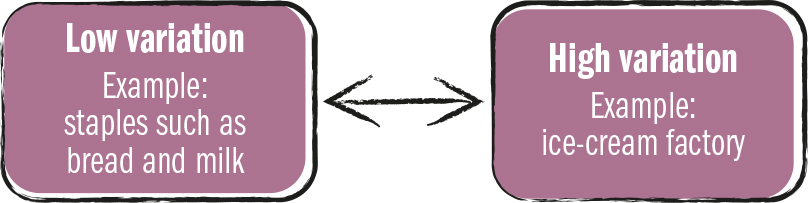
Source 3.10 Variation in levels of demand for a product or service will influence a business’s operations.
Source 3.10 Variation in levels of demand for a product or service will influence a business’s operations.×
Operations will be strongly influenced by variations in demand over time. Variation can change according to time of day, season, public holidays and time of year. Where there is a steady, predictable level of demand with little variation, operations will be similar to those that produce low variety and high volume. That is, operations are routine, with low unit costs and using more capital than labour. When there is volatility in the pattern of demand, operations will need to be highly flexible. The operations manager will need to anticipate and plan for changes in demand and have a high level of contact with the market. Technology will be used so that the business can respond quickly to changes in demand.
Visibility
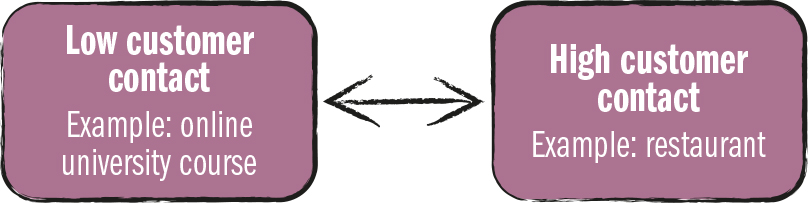
Operations will also be influenced by the degree to which customers can see the operations in action. Service-based businesses will have a high level of visibility, while customers will rarely see the operations process of a manufacturing business.
Source 3.11 Physical retail outlets have a higher level of customer visibility than online operations.
Source 3.11 Physical retail outlets have a higher level of customer visibility than online operations.×
The implication for operations of a highly visible operations process is that the quality of labour will be significant. Operations will need to have well-trained, highly skilled, adaptable staff who are able to handle the individual needs of customers. A close relationship with the human resources function will be essential. Speed of operations will also be important, as customers usually have a much lower tolerance for waiting. So short time lags between customer ordering and delivery will be needed; otherwise, the customer may change to a competitor.
Many businesses may have a mixture of operations with high visibility for some aspects and low visibility for others. For example, the operations by bank tellers will be highly visible, while back office operations such as processing credit card transactions and managing loan contracts will not be seen. Further, this low visibility has allowed many banks to offshore these processes to countries such as India to reduce operating costs.
A business can change from having a high-visibility operation to having a low-visibility one. For example, a retailer may decide to close their physical shop and move to only selling products online. The changing nature of how customers shop means that a high level of personal customer contact is no longer always necessary to make the sale.
Influence of the four Vs
Of the four Vs, the most significant influences on the operations process will be volume and variety. A business that chooses to produce a high volume will be limited in its flexibility to produce a large variety or respond quickly to a change in demand. A business that is strongly influenced by changes in consumer preferences will tend to produce a higher variety of goods and, unless the business has very sophisticated technology, will produce in lower volumes.
Source 3.12 Influence of the four Vs on operations
Source 3.12 Influence of the four Vs on operations×
The four Vs will also be influenced by the product life cycle. During the establishment phase there will be a slow growth in demand and volume, with a higher level of customisation or changes in design. A business can expect demand to increase dramatically once it has passed through the establishment phase and entered the growth stage, increasing the volume the business must produce. Once in the maturity phase, the business will have low variations in demand and may offer more variety to attract different target markets. As the business enters the decline phase, demand and volume will fall and some variations on the standard product will be deleted from production.
Therefore, businesses need to be flexible in their capacity, and have access to resources and the use of technology to meet these changes in the four Vs over the life cycle of the business.
Copy Source 3.12 and indicate on the diagram the influence of the four Vs for the following operations:
car assembly factory
takeaway pizza shop.
Business Bite
McDonald’s, originally established in the 1930s, is one of the most recognised brands in the world. It was a franchisee, Ray Kroc, who realised how the application of a formal operations process and standardisation could provide a competitive advantage in this industry. Speed of service and quality are key performance objectives. Interestingly, McDonald’s menus have a customer perception of variety; however, this is not really the case. In terms of the influence of the four Vs, variety is low. Standardisation is one of the key operations strategies used by McDonald’s to achieve cost leadership. By minimising the number of ingredients and arranging them in different combinations it is possible to provide different meal outputs. Twenty-two different food inputs can be combined in over 600 ways so that a comprehensive burger menu can be provided to customers. Volume is high through a mass process system relying on assembly lines. Visibility is low, as customers typically don't see the kitchen operations and only encounter frontline staff. McDonald’s has low variation in demand, as the menu can be adapted for different seasons and therefore the level of sales remains consistent. In 2014 McDonald’s introduced a degree of customisation, and therefore job production, with the Create Your Taste initiative. Customers could design their own gourmet burger in six steps via a self-serve kiosk. This initiative aimed to appeal to an additional target market, the discerning diner. However, the program was abandoned in 2016 because it was too costly and slowed down kitchen operations with complicated orders leading to longer wait times. Instead, a new, less customisable product line called Signature Crafted Recipes was introduced, and has proven to be far more successful.
Scheduling and sequencing
Scheduling and sequencing tools are used to identify all steps in the operations process and organise them into the most efficient order to complete. Tools such as Gantt charts and critical path analysis are used by project managers to help in planning complex projects with multiple interrelated parts. Scheduling and sequencing tools will need information about:
what production activities are used
when a particular activity will occur
how long an activity will take to finish
what activities are independent and can therefore occur at the same time
what activities are related so that one has to occur before the other
what resources will be used.
Therefore, a key role of the operations manager when scheduling and sequencing is to perform a detailed task analysis to determine the separate parts of the entire process of making a good or providing a service. Task analysis is the breakdown of all the steps needed to manufacture a good or provide a service.
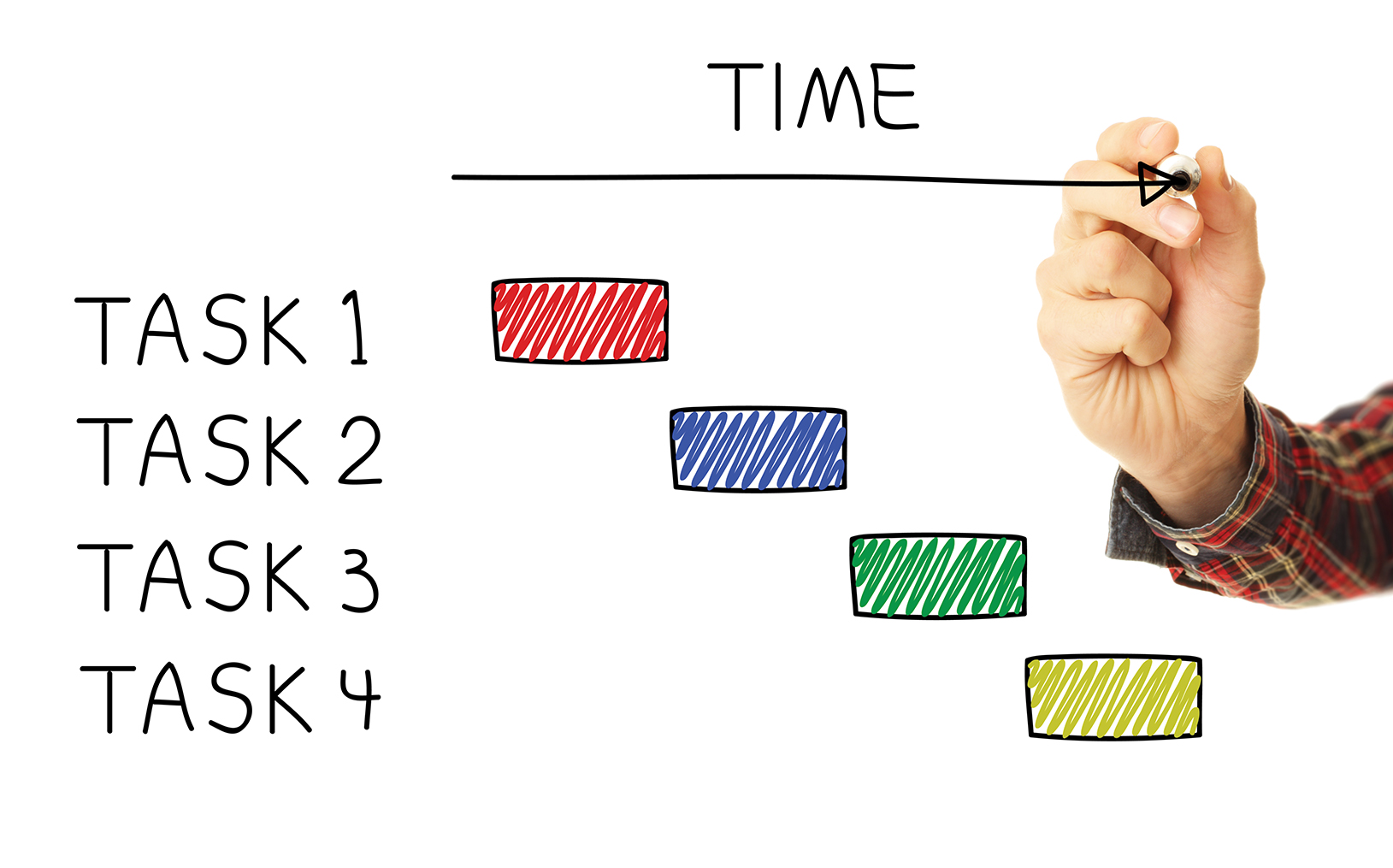
Source 3.13 Scheduling and sequencing tools such as Gantt charts help businesses to plan complex projects with multiple interrelated parts.
Gantt charts
One of the most common scheduling techniques is the Gantt chart. A Gantt chart records the number of tasks involved in each particular project and the estimated time needed for each task. The business can set specific dates for the completion of each stage of operations.
These dates are sometimes referred to as ‘milestones’. At each of these points critical decisions may need to be made. A business that organises production based on customer orders may use a Gantt chart for production scheduling. The chart may show the schedule for orders on a day-by-day or week-by-week basis, using bars to show the starting and completion dates for each order. In this case, the milestones would allow the firm to quote the dates for the completion of future orders and be the basis for rostering additional staff and determining the schedule for future business operations.
The Gantt chart allows the business to compare actual progress to its originally planned progress. Businesses that do not keep to production targets may find that their customers move to other suppliers.
Construct a Gantt chart based on the following passage.
Building a house is a project that requires careful planning; otherwise expensive mistakes can be made, such as having to remove a concrete floor to install plumbing. Task analysis has indicated that there are many different tasks that must be performed and that some can occur at the same time as others. First, the architect must finish the design and plans for the builder. This takes a total of four weeks. Once all the approvals have been granted (taking two weeks), the foundations can be laid. While the foundations are being finished (1 week), the builder will order all the necessary materials for building the house (1 week). Before the bricklayers begin, the plumber installs all the taps, pipes and outlets that are needed (2 days). The work of bricklayers, carpenters and electricians takes four weeks. Once their work has finished, the plumber will finish installing the bathroom and kitchen fittings, which only takes three days. The house will then be painted and carpeted (2-3 days for each). Painting occurs before the carpets are laid so that they are not damaged. After a final inspection the project manager may have some minor corrections or work to finish (1 week) and then the house is ready.
Critical path analysis
A critical path analysis (CPA) is an appropriate scheduling tool for use in an operation that involves a series of repeated tasks. The ‘critical’ aspect is those tasks that cannot be changed without having an impact on the time it takes to complete the operations process.
A CPA flow diagram shows the interrelationship of tasks. As all tasks need to be completed for the project to be finished, the critical path time period is the longest path taken to complete the whole project. To calculate the critical path, all the parts that make up the longest path are added together. This gives the shortest time without delays. In the CPA shown in Source 3.15, the longest path is from A to G to H to I to F = 4 + 4 + 4 + 4 = 16. Therefore, the completion time for this business would be 16 weeks.
Note: in Source 3.15, some of the components at G need to be processed through H before they are joined together with the other G components at I. Think of the paths as being like a book, where the front cover has special pictures on it and the back cover is blank. The G to H to I path may be like the front cover, which takes longer than the process from G straight to I, which could be the back cover.
An effective operations manager will also include the effects of delays. In addition, the finance manager can use CPA to organise the correct amount of funding for the operations process and determine the impact on cash flow.
Source 3.15 Critical path analysis (03:23)
Technology, task design and process layout
Technology is often understood as highly specialised equipment and computers used by a business or in a factory. Task design and process layout will be used by an operations manager to use this technology in the most efficient and effective way.
Technology
Technology is a key input into the operations process. A business may wish to achieve a sustainable technological advantage over its rivals by using leading-edge technology – that is, the most recent and innovative technology – in its operations. A more conservative strategy would be to use technology that has already been established, tried and proven in operations without the risk of investing in a new technology that may fail.
Computer-aided design (CAD), computer-aided manufacturing (CAM) and robotics are technologies used in operations processes, and have been described in Chapter 2. The improvements in the machines, equipment and devices used to transform inputs into outputs are called process technologies.
Even the most labour-intensive industries use process technology. For example, a local organic farmers’ market may use wireless EFTPOS machines so that customers pay with Visa payWave, MasterCard PayPass or their mobile phone. Product technology is quite different, because this is innovation in the products themselves. Smartphones are a good example of an innovation in analogue mobile phones.
Technology can improve the competitiveness of operations by giving it more flexibility, as it allows the business to respond to changes in the market more easily. The business can change volumes to meet a sudden increase in demand or produce different variations of products to satisfy changing consumer demands. Technology also allows a business to produce non-standardised versions of its standard product to satisfy individual clients. This is in addition to the commonly understood improvements to productivity: less waste and more efficient use of time.
Perhaps the most significant impact on businesses from process technology in recent years is the application of computer software modelling programs, the internet and wireless communication to the operations process.
Flexible manufacturing systems (FMS) are an integrated approach to using technology and will have an impact on task design and the layout of the manufacturing facility.
This type of manufacturing can perform multiple tasks at once, reducing the number of individual tasks performed by separate pieces of equipment. Rather than have a process or a product layout, the business may have semi-independent automated workstations to which all the inputs are transported.
Task design
The operations process determines what tasks are to be completed to finish a project. Management decides how each task will be completed. This is referred to as task design.
Each individual task is analysed and broken down into separate steps and allocated to machines and employees with the appropriate skills, knowledge and capabilities. Some employees may need training to improve their skills. Even if the process of operations is already established, task design allows ongoing analysis and adjustments in each activity to ensure continuous improvement in productivity. New ideas, technological change, training and the skills of the workforce available will necessitate continual revision of the operations process in order to maintain competitiveness.
Source 3.16 The operations process determines what tasks are to be completed to finish a project. Management decides how each task will be completed, through a process known as task design.
Process layout
Once the task has been analysed and the technology requirements determined, the next strategic decision is to plan the physical layout of the business’s factory or office. This is called facilities layout planning. Layout will also be influenced by the size of equipment, work areas and storage space. The objective is to have as efficient a flow of resources through the business as possible.
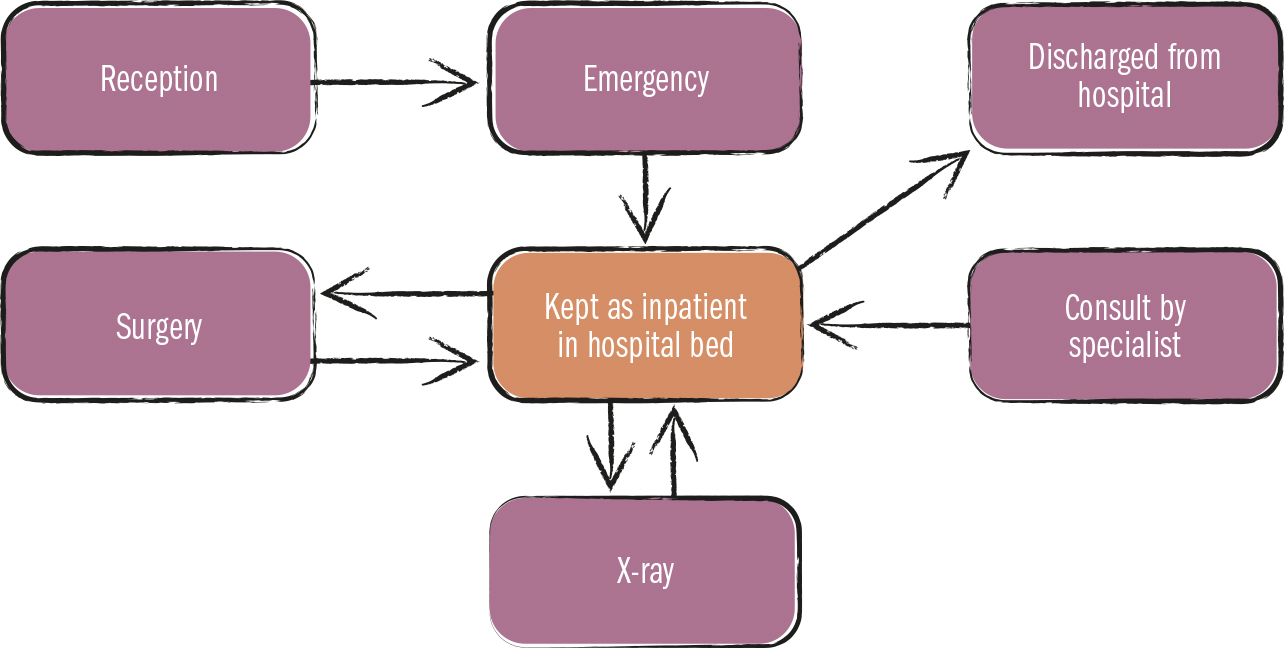
A process layout is one in which all the machinery is arranged by what it does; that is, the functions used to make the good or provide the service. The product moves from department to department, depending on what transformation is needed. This allows for more flexibility and customisation of the product. This is also known as a functional layout. Illustrative examples include a factory such as a bakery, where some food items will need decorating and others will not; or in an office, where certain roles are placed together such as marketing or human resources. A process layout requires staff to be specialised and know how to use the equipment and tools in their department.
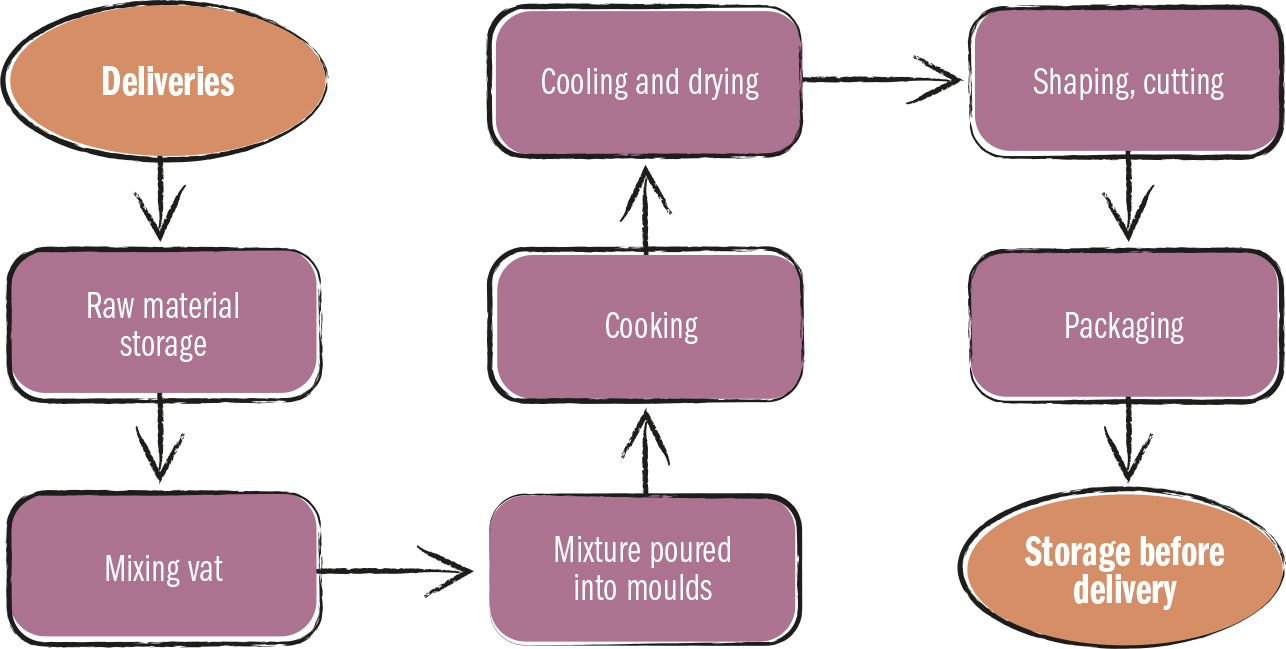
Process layout is quite different from product layout, in which the product moves from station to station, such as in a car assembly line. Product layouts are used for assembly line manufacturing to make a particular product or good.
Source 3.17 Finance must support each of the other business functions.
Source 3.17 Finance must support each of the other business functions.×
Source 3.18 Product layout diagram for a food manufacturer
Source 3.18 Product layout diagram for a food manufacturer×
Monitoring, control and improvement
Source 3.19 Monitoring, control and improvement occur at each stage of the operations process.
Source 3.19 Monitoring, control and improvement occur at each stage of the operations process.×
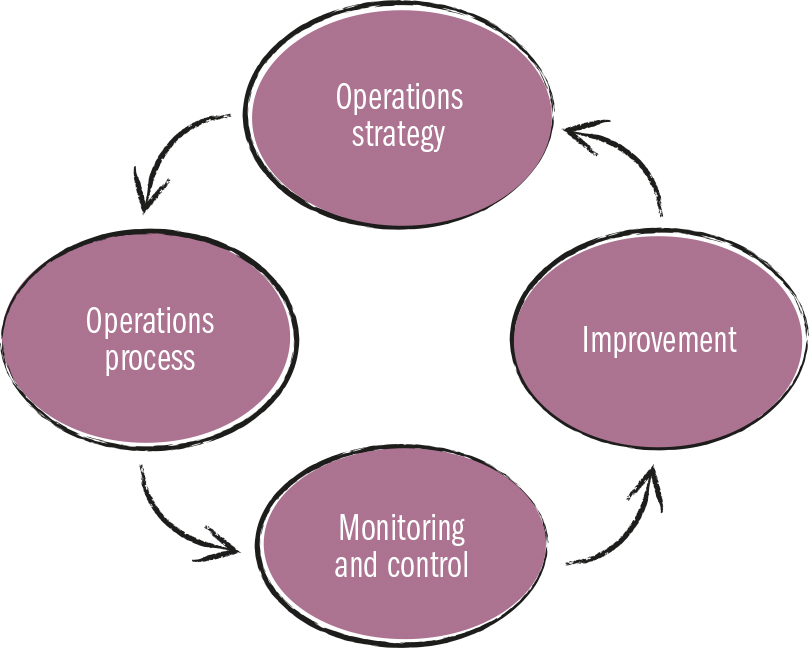
No matter how well managed they are, operations can always be improved. Monitoring, control and improvement relate to performance objectives of quality, speed, dependability, flexibility, customisation and cost in operations. Quality management systems are discussed in detail in Chapter 4. Monitoring, control and improvement are illustrated in Source 3.19 as they occur at each stage of the operations process.
A business needs to know accurately how well its current operations are working in order to make improvements. Managers will find it difficult to assess the performance of operations and make improvements without adequate information. Data will be collected about the following:
operations costs
the amount of waste from operations, such as leftover materials
the number of defects and substandard goods
the quality of the product
the speed of manufacturing or response time to customers’ requests
the volume of output.
This data is also called key performance indicators (KPIs). KPI reports are used to monitor operations with respect to key performance objectives.
Source 3.20 Key performance indicator (KPI) reports are used by businesses to monitor operations and judge how the business is performing.
Key performance objectives of operations will not be achieved without adequate monitoring of operations and controls to ensure that operations are ‘on track’ and that strategies are used effectively to make improvements.
The purpose of monitoring and control is to ensure that the operations process runs efficiently and effectively, producing the goods and services it was designed for. Control is a management function that aims to keep the business’s actual performance as close as possible to what was planned by making adjustments to the operations process. It is coping with changes as they occur; for example, changes in demand.
Adjustments and changes may need to be made to day-to-day activities for the short term, and even the entire operations process for the long term. Effective controls ensure that the business makes and supplies an appropriate quantity of its products, in an appropriate time and to the required level of quality according to what is planned.
Key questions that must be answered by the manager are whether the current operations are satisfactory and where improvements can be made.
Improving operations is a key strategic goal of all businesses. Businesses will compare themselves against competitors and industry benchmarks in order to determine areas that need improvement. Generally, a business will seek a competitive advantage through improvements in the following areas of performance:
Source 3.21 Monitoring, controlling and improving process
Source 3.21 Monitoring, controlling and improving process×
quality – by getting it right the first time and having defect-free products and error-free services
speed – by increasing speed of production and delivery of services
dependability – by being on time with a reliable operations system, equipment and employees
flexibility – through having processes that are able to change and offer new products and more choice
cost improvements – by being efficient and productive to offer more value.
In this manner, improvements in operations will be the source of competitive advantage for the business. The challenge is to maintain continuous improvement and a system like total quality management (TQM) will assist in obtaining this.
Business Bite
The car market in Australia is highly competitive, such that companies aim to reduce costs as much as possible. A number of Chinese manufacturers have entered the budget end of the market. Great Wall made a grand entry in 2009, while small numbers of Chery, Foton and Geely have also sold in the Australian car market. Haval, China’s biggest SUV brand, entered the Australian market in 2015. In 2018 its entry level SUV still sold for under $20 000. These companies focus on manufacturing large volumes of vehicles to minimise the average cost per vehicle (economies of scale). Offering a limited variety of models also assists with this cost leadership strategy. However, this strategy has not been successful in Australia. At its peak in 2012, Chinese brands sold only 12 000 individual cars in Australia. This is despite their relatively low price compared with US, Japanese and European brands. Feedback and market research indicated that potential Australian customers have doubts about the quality, reliability and safety of these imported brands. So, although Australians are happy to purchase computers, phones and clothes made in China, they are not keen to drive Chinese-manufactured cars.